Tuesday, November 23, 2010

"Akiko on the Planet Smoo" by Mark Crilley

Okay, everyone, listen up!  Time for a little “Stranger Danger” review.  Suppose you are ten years old and receive a cryptic, silvery metallic letter that does not bear a return address and is emblazoned with the warning that it is to be read by you alone “and no one else.”  Would you show the envelope to your loving and attentive mother hovering outside your door?  Lets say you push on and open this mysterious envelope as your best friend looks on giving you advice (yes, you ignore that pesky “for your eyes only” command).  Imagine that it contains a note saying, “We are coming to get you.  Meet us outside your bedroom window tonight at 8:00.  Don’t forget your toothbrush.”  Lets recap, stranger-danger pupils: “We are coming to GET YOU”  (emphasis added by a concerned mother). Perhaps it would be wise not to listen to your best friend tell you that it’s probably a joke and heed your years of instruction and hand that note over to a supervising adult.  NOW.  Finally, assume that you shrug off your extensive stranger danger training and wait until 8:00 to make your decision.  At the appointed time, you discover that two aliens have arrived in a spaceship to take you to the planet Smoo.  Would you balk when they produce a robot in your exact likeness to replace you for the two weeks you’ll be gone?  Well, as a mother, I am happy that you are bringing your toothbrush but am not too keen that you are ready to hop in that spaceship and take off!   In a stranger danger scenario, you would be evaluated (kindly) as “Needs Improvement.”  But as an adventurer and children's fantasy book  heroine, you would be deemed intrepid and engaging.  Just like Akiko!
Akiko is the heroine of ten fantasy adventure books by Mark Crilley.  Akiko on the Planet Smoo launches this popular series, based on Crilley’s comic book series of same name.  The books are humorous, highly readable texts that chronicle Akiko’s adventures as she leads a cohort of misfit alien characters on missions for King Froptoppit.  In this first book, Akiko and her companions embark on a mission to rescue Prince Froptoppit from the evil and crazy Alia Rellapor, the sworn enemy of the King.  On Earth, Akiko was reluctant to become captain of the fourth-grade safety patrol but when called upon for this mission on Planet Smoo, she girds herself and agrees to serve as leader. 

Crilley employs a light conversational tone and displays a flair for dialogue in this humorous and lighthearted book.  This alien world is bright and positive and poses few frights or sad moments.   His short chapters are manageable and serve to drive the action at a strong pace.  In addition, Crilley remains true to his cartoonist roots and offers charming illustrations that support his plot.  For example, he describes Poog, one of Akiko’s stalwart companions, as “really little more than a floating head.  He had two eyes, one mouth, and no nose.  He was almost perfectly round and covered by pale purple-white skin that shimmered like smooth leather.”  Fortunately, Crilley juxtaposes this passage with a detailed drawing of Akiko’s introduction to Poog, thus scaffolding our understanding of the appearance of this key character.

The Akiko series is appropriate for third grade readers and above.  On www.markcrilley.com, the author introduces the Billy Clikk series and “Miki Falls” manga books, his other fantasy books geared for older readers. My son enjoyed the Akiko books from third to sixth grade.  I remember him laughing out loud at Akiko’s encounters with alien life and eagerly sharing funny stories from the first five books in the series.  I had never read the books myself.   I appreciate the humor and the appeal to young readers and certainly would recommend their inclusion in a classroom library.  The Akiko books might prove highly appealing for independent reading, especially for students who gravitate to fantasy, science fiction, adventure, or a text with a comic sensibility.

Tuesday, November 9, 2010

"A Long Way from Chicago" by Richard Peck

Richard Peck offers a glimpse of Depression era rural Illinois in his masterful episodic “Novel in Stories” that is A Long Way From Chicago.  Peck is the author of more than three dozen novels for young adults. His 1998 Newbery Honor book is ideally suited as a read-aloud for older elementary students.  The stories provide strong characters, humor, and relatable depictions of life told from the perspective of a boy visiting with his younger sister for a week with their grandmother.  It might be an annual trek a long way from the bustling excitement of Chicago but siblings Joey and Mary Alice find small-town domestic adventure in the house alongside the railroad tracks.  Peck depicts the small pleasures of immersing a bare arm in a cool ice bucket on a hot August day as well as the chills and scares of walking home from an outdoor viewing of a Dracula movie.

Grandma Dowdell is a strong quirky woman who is decidedly not the sort of grandma who smothers her visiting grandchildren in hugs as they step off the train.  Instead she’s the kind of woman who is certainly not averse to bending (or breaking) a few rules (or laws).  With her two city grandchildren following behind, Grandma sits up overnight with a corpse, brings them poaching for fish, lies in wait for robbers, and tells many a whopper of a tale looking straight in the eyes of her neighbors.  However, Grandma stands up for her view of justice.  She feeds hungry drifters being escorted out of town, hides a young girl from her abusive mother, and succeeds in restoring a foreclosed home to her “worst enemy.”

As the novel progresses and the children grow from young children to teenagers, Grandma Dowdell also transforms.  In glimpses, we see her soften.  A gift plane ride is wrangled in one story and a tear is wiped away in a later tale.  Slowly a more nuanced portrait emerges of a woman who was first presented as a towering and uncommunicative enigma.  Words of familial love and affection are not depicted in Peck's novel.  Even during the children's last summer visit, protracted grandmotherly squeezes and cuddles are not proffered:  “She came to the depot to see us off on the day we left.  It was to be our last visit together, and I suppose she knew.  But she didn’t say so.”  Commitment and love are shown through Grandma Dowdell’s fierce loyalty and actions.  In the final page of this humorous and ultimately poignant novel, Grandma Dowdell’s love for her grandson blazes with light out into a dark night and my tears flowed. 

Tomorrow, I’m heading straight to the library to get Peck’s sequel: 2001 Newbery Medal winner, A Year Down Yonder.  Years ago both of my children enjoyed and recommended these two novels yet I did not read them.  Perhaps I was too engrossed in my own reading or simply busy with work.  What a lost opportunity to share these wonderful tales in our family.  Time to rectify my omission.  Stay tuned.  I wonder if my now-adult children still remember Grandma Dowdell.  I am unlikely to forget her.  Especially that last image of an old woman waving at a passing train in the wee hours of a wartime morning.

Tuesday, October 26, 2010

"Feathers" by Jacqueline Woodson

Jacqueline Woodson’s spare, beautiful novel bursts with powerful emotions of grief, love, hope, faith, and yearning.  As the title suggests, the plot and language of Feathers seem to float lightly for our consideration, giving the reader time to ponder and appreciate the strength and beauty of human connections and our shared hope for the future. 
This lovely, quiet coming-of-age story is set in the 1970s and references Vietnam and the Black Panther movement. Woodson delicately addresses weighty topics such as bullying, segregation, isolation, infant mortality, and religion.  The eleven-year-old African American protagonist, Frannie, lives in an insular and safe community separated by a highway from a white world of opportunity and privilege.  She lives in a loving home with her parents and an older brother who is deaf.  Frannie feels different from her peers not only because she communicates in sign within her family but also because they have suffered the death of one infant and the miscarriage of two other pregnancies.  In addition, a virulent case of chicken pox kept Frannie from entering this new school on time with her classmates one September and left her with a pox in the middle of each palm “like nail holes.”  She feels an enduring separation from most of her classmates.

When a new boy enters the classroom in the middle of the school year, Frannie empathizes with his isolation. She is discomfited by his caucasian appearance and his serene tone but when he spontaneously communicates with her using American Sign Language, Frannie feels a further connection to this unusual boy.  Why is a white boy living and going to school on this side of the highway?  Why does he not respond to taunts?  Some classmates wonder if this nameless boy might in fact be Jesus.  Frannie questions why she is so intrigued by him and must admit that she too wonders about whether Jesus would come back to a community like hers.

Woodson bookends her novel with an Emily Dickinson poem that has captivated Frannie.

“Hope is the thing with feathers
that perches in the soul,
And sings the tune without the words,
And never stops at all.”

Frannie wonders about the meaning of the metaphor eventually concluding, “the writer was thinking about how light feathers are and they can just float everywhere.  And I guess that’s how hope is too – all light and everywhere like that.  There’s hope in this house.  And at your church… Everywhere.”

I relished the quietness of the book.  "Snow coming down like feathers" provides the backdrop to the majority of the novel and seems to muffle the anxiety of school, home, and community.  Families embrace and then fall asleep in one another’s arms.  Music is enjoyed through vibration rather than sound.  Friends hold hands as they walk together to church.  I particularly enjoyed Woodson’s depictions of mundane household vignettes that illustrated the deep love and connection within the family.  The entire book seemed to read like a graceful poem.  My library copy is rife with sticky notes marking beautiful passages and pages that brought me to tears.

Jacqueline Woodson is the author of more than two dozen picture and young adult books.  She is a winner of the Coretta Scott King Award for Miracle’s Boys and of two Newbery Honor Awards for Feathers and Show Way.  Although familiar with some of her picture books, I have been unaware of Woodson's young adult fiction.  After Feathers, I am now planning to read her other works.  My interest (like Frannie's) is definitely piqued.

On  her website, http://www.jacquelinewoodson.com/, Woodson notes that she loves writing “because it makes me happy. Even when the words are slow in coming and the story seems all lopsided, writing keeps me happy.”  Her joy shines through in “Feathers.”  Even with its pervasive undercurrent of pain and worry, hope and optimism win out and I felt moved and positive.  While I am uncertain whether young adults can reap the full benefit of Woodson’s many themes, I am confident that late elementary and middle school students will relate to Frannie’s life and dilemmas.  Woodson’s novel rings true and her message is uplifting.

Monday, October 11, 2010

"Ride a Purple Pelican" and "Beneath a Blue Umbrella "by Jack Prelutsky

Ride A Purple Pelican and Beneath A Blue Umbrella
by Jack Prelutsky

Books can transport you  - not just to the scene or setting described within but also to a past moment when that book loomed large in your life.   For me, Ride A Purple Pelican and its sequel Beneath a Blue Umbrella warp time and distance to transport me back to the years of early parenthood when I would sing these rhymes to two small children lounging contentedly in my lap.  Prelutsky’s rhymes are often wacky, sometimes lyrical, and undoubtedly delightful when sung to a self-created melody or simply just read straight.


"Ride a purple pelican,
ride a silver stork,
ride them from Seattle
to the city of New York,
soar above the buildings,
bobble like a cork,
ride a purple pelican,
ride a silver stork."

Often incorporating the names of American and Canadian cities, states, regions, and provinces, these poems are alliterative, funny, and highly rhythmical.  Young children soon become familiar with North American place names from Chicago to Saskatoon as they read these animal, human, and nature fables. Each collection includes 28 short poems and is organized with a single poem on the left page and its accompanying framed illustration on the right.  The book’s structure, Garth Williams’ watercolors, and Prelutsky’s highly readable poems work together to render these two collections highly accessible for even young preschoolers. 

Williams, illustrator of Charlotte’s Web and The Little House series, does not overload the reader with distracting details but enhances Prelutsky’s poems with beautiful visual counterparts.   He created colorful and whimsical depictions of frogs in tuxedoes, turkeys in cowboy hats, and even sad looking potatoes:

"Poor potatoes underground
never get to look around,
do not have a chance to see
butterfly or bumblebee.

Poor potatoes never look
at the fishes in the brook,
never see the sunny skies –
what a waste of all those eyes!"

Prelutsky is a highly prolific author of more than 50 poetry collections for children. He confesses to disliking poetry as a child but later realized that “poetry was a means of communication, that it could be as exciting or as boring as that person or experience.”  (http://www.poets.org/poet.php/prmPID/68)   Prelutsky was named the inaugural winner of the Children’s Poet Laureate award by the U.S. Poetry Foundation in 2006.  At http://www.jackprelutsky.com/, he offers tips for reading to young children and suggestions for classroom activities including “How to Write a Funny Poem.”

As a parent, I found these poems utterly charming and appealing for my children and for myself.  They are highly enjoyable to read; the alliteration and rhythms make the stanzas trip off your tongue.  Ride A Purple Pelican and Beneath a Blue Umbrella are not stored in the attic but remain on our bookshelf, readily available for visiting nieces and nephews. In homage to the Tidewater Virginia area, I close with a favorite Prelutsky poem from Beneath a Blue Umbrella:

"Four fat goats upon a boat
sailed south from Newport News,
and there the four ate clothes galore,
they swallowed socks and shoes.

They chewed on boots, on shirts and suits,
they shared a sweater vest,
a dozen coats went down those goats
before they reached Key West."

After all, what’s not fun about clothing-eating goats on a boat?  Well, just try singing it and it’s even more amusing both for you and your audience.

Sunday, September 26, 2010

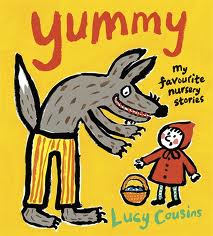
Yummy by Lucy Cousins

Yummy by Lucy Cousins

Food is central to our lives, our pleasures, and apparently our fairy tales!  In Yummy:  Eight Favorite Fairy Tales, Lucy Cousins’ lends her cheerful, bold artistry to traditional stories that, upon further reflection, do indeed focus on food.   She vividly depicts food that is savored and gobbled, well earned and stolen, vegetarian and fully carnivorous.  Meals serve as a celebration of moral instruction (e.g., The Little Red Hen does not share the fruit of her labors with her lazy friends) and the triumph of good characters over villains (e.g., the Bremen Town Musicians vanquish the robbers).

Four of the eight tales feature some degree of peril and Cousins never sanitizes the predation and menace of these time-honored fairy tales.   Disney’s Little Mermaid might have escaped the sea foam fate of Anderson’s original plot but Cousins does not spare two of the Three Little Pigs from the jaws of a voracious wolf.   Although her art and spare text gear her book towards younger children, Cousins does not shy away from the original sad fates of her traditional characters.  “Hee hee hee” reads the banner across the top of the page as “CRUNCH!  MUNCH! Foxy Woxy gobbled up Goosey Poosey” and friends in the tale of  “Henny Penny.”   Happily, the chicken heroine escapes the fate of her friends as she runs home as fast as she can.  Her text is simple, rhythmic, and accessible for preschoolers and young elementary students.

Cousins is fearless in her retelling of these tales.  In "Little Red Riding Hood," is the wolf smiling gleefully as he swallows Grandmother whole?  Why, yes, indeed he is.  In Cousins’ painting, Grandmother’s feet and nightdress protrude prominently from the wolf’s smiling mouth and the artist adds “gulp!” in large black font next to the victim’s splayed white toes.  A few pages later, she repeats this graphic technique, embellishing the wolf’s decapitation with the bold proclamation of “chop!”  The wolf’s death is portrayed as bloodless but it is still a jolt to see an axe hovering above the wolf’s body while Little Red Riding Hood and her grandmother celebrate on the opposite page beneath the wolf’s flying head. 

According to Barnes and Noble and Amazon, British author-illustrator Lucy Cousins has published more than 300 books.  Her Maisy the Mouse series is ubiquitous on preschool bookshelves and in family libraries.  Personally, I have never been an avid fan of Cousins’ art.  While I am drawn to her bold palette and joyful tone, I have not been attracted to her simplistic black outlines and primitive style.  However in this particular book, Yummy‘s charming and childishly-rendered art seems to lower the emotional load of these clearly gruesome stories.  Cousins repackages the often-fearful villains in a vibrant, colorful, and naïve manner.  In so doing, she successfully declaws these villains and focuses on the fantasy aspect of the story and the ultimate triumph of the heroes and heroines.  Hungry wolves eventually end up in the stewpot and Goldilocks finally leaves the Three Bears to enjoy their porridge in peace.  The stories always end well for the main characters.
   
Parents of young Maisy fans might find Yummy to be a palatable means to introduce their young children to traditional fairy tales.  Turnips, porridge, and even a huffing-puffing wolf are all served up in this tasty collection of stories.  Dig in!

Monday, September 13, 2010

Wabi Sabi by Mark Reibstein, Illustrated by Ed Young

Wabi Sabi by Mark Reibstein is a strikingly beautiful picture book that addresses a fundamental tenet in Japanese culture.  A Kyoto house cat is called wabi sabi after the Japanese aesthetic ideal of the same name.  On the title page, Reibstein defines wabi sabi as “a way of seeing the world that is at the heart of Japanese culture.  It finds beauty and harmony in what is simple, imperfect, natural, modest, and mysterious.  It can be a little dark, but it is also warm and comfortable.  It may best be understood as a feeling, rather than as an idea.”

Wabi Sabi, the cat, sets out through the streets of Kyoto in a quest to discover the meaning of her name.  She travels across an urban landscape and enters a wooded park where she discusses the meaning of wabi sabi with a wise monkey.   At a prominent Kyoto shrine, Wabi Sabi “ found the place to be very beautiful – in a wabi sabi kind of way.  Although the buildings and gardens were shaped by humans, they were neither fancy nor grand.”  In the end, the cat returns to the simple straw mat of her kitchen, content and warm.

This ambitious text is uneven.  The inclusion of haiku into the narrative flow is occasionally successful.  When the cat receives a cup of tea, she feels
“A warm heavy bowl
comfortable as an old friend –
not fine, smooth china.”
However, I find that the prose is generally disrupted by the clumsy inclusion of haiku that does not deepen or forward the text.  In addition, to my ear, even when eliminating most of the jarring haiku, the text itself is not smooth and might not be appropriate as a read-aloud.  Finally, I am somewhat confused about the potential audience for the upper level content of the story.  Unless they have an existing cultural grounding and understanding of wabi sabi, younger children might indeed remain unclear about this aesthetic ideal.  Reibstein makes allusions to the wabi sabi definition rather than offering explicit explanation.  I strongly disagree with the Barnes and Noble age range notation that this challenging book is targeted for infants (!) or children in preschool.  Older children will find more enjoyment and comprehension in this text.

With this caveat on the narrative content of the book, I heartily recommend Wabi Sabi for its phenomenal art.  Ed Young has created another glorious chapter in his magnificent portfolio of children’s illustrations and the publisher has augmented Young’s art with Japanese kanji haikus and chop style formats for the author and illustrator credits.  Illustrator of more than eighty books, Young won the Caldecott Medal for Lon Po Po in 1989 and has twice received Caldecott Honors for Seven Blind Mice and Yeh Shen.  Wabi Sabi has reaped numerous honors including recognition by the American Library Association and the New York Times Book Review as a notable children’s book. 

In homage to Asian scrolls and literary norms, Young’s marvelous collages are oriented vertically.  Using a broad range of found and natural materials from his home, Young creates a rich, textured, three-dimensional quality to his illustrations.  The result is impactful and engaging.  The work is an amazing accomplishment considering the fact that Young completed this assignment under a short deadline after his initial two-year project of Wabi Sabi illustrations disappeared!  Young had already discarded his original, high-quality and purpose-selected art materials, so he “decided to use wabi sabi materials” and ferreted out resources as varied as dryer lint and corn husks to create his magnificent art.
http://howtobeachildrensbookillustrator.wordpress.com/2008/11/17/the-breathtaking-collages-of-ed-young-in-wabi-sabi-2/

All the World by Liz Garton Scanlon

All the World by Liz Garton Scanlon, Illustrations by Marla Frazee


Need a vicarious vacation?  How about a beach outing on a breezy weekend day?  The smooth poetic rhythms and panoramic images of All the World by Liz Garton Scanlon channel relaxation and ease.  This lovely book seems a natural choice for a quiet interlude or bedtime cuddle.  Although filled with activity and companionship, the text projects a steady reassuring tone and the illustrations depict warm interactions between family and friends over the course of a summer day.

Drawing upon a laundry list of selections from recent New York Times’ recommendations, I was initially attracted to All the World by Marla Frazee’s striking cover illustration.  Two young children are viewed from behind, highlighted against a background of a towering cumulus cloud as they stand on a sand dune overlooking the sea.  Awarded her second Caldecott Honor for All The World, Frazee features a multicultural cast of characters in her sweeping artwork including a relatively rare portrait of an interracial family.  The illustrations alternate between vast natural vistas and intimate family scenes and provide great opportunities for interaction with the reader.  Is family from the beach at the market?  Has the man with the wagon joined the gathering at the fountain?  Have the bicyclists arrived at the restaurant and house?  Frazee does a particularly effective job in conveying the descending darkness, the routines of a closing day, and the cozy connections that define human relationships.  Her paintings of hugging parents, a mother nursing a baby (while studying textbooks), and a father nuzzling his infant pair perfectly with the last pages of text: 
“All the world is everything
Everything is you and me.”

Ultimately, the poetic text clinched my decision to tuck Scanlon’s picture book into my bag and take it home.  All the World is a natural read aloud.  It has the rhythm and refrain of a classic: 
“… All the world is wide and deep.
…  All the world is old and new.
…  All the world has got its sky.”

Scanlon’s words roll out like a long-loved lullaby.  I can imagine making this assured and lyrical book a cornerstone of a bedtime routine.  When shared with a sleepy child, the poem is an enticement to put away the cares of the day and relax into the comfort of soft pillows and a warm bed:
“Spreading shadows,
setting sun.
Crickets, curtains, day is done
A fire takes away the chill
All the world can hold quite still”

The book concludes …
…Hope and peace and love and trust
All the world is all of us.”

For me, the mood created by the modulation and sounds of these words is reminiscent of some of our family’s favorite bedtime selections including Margaret Wise Brown’s Goodnight Moon and Sandra Boynton’s The Going to Bed Book.  I can envision this charming and beautiful book as a natural addition to that select list of beloved books read just before a precious kiss goodnight.  All the World is a true gem.